
Hospital logistics · · 5 min read
Chain of Custody and Patient Data: What the Best Hospital Logistics Companies Do Differently
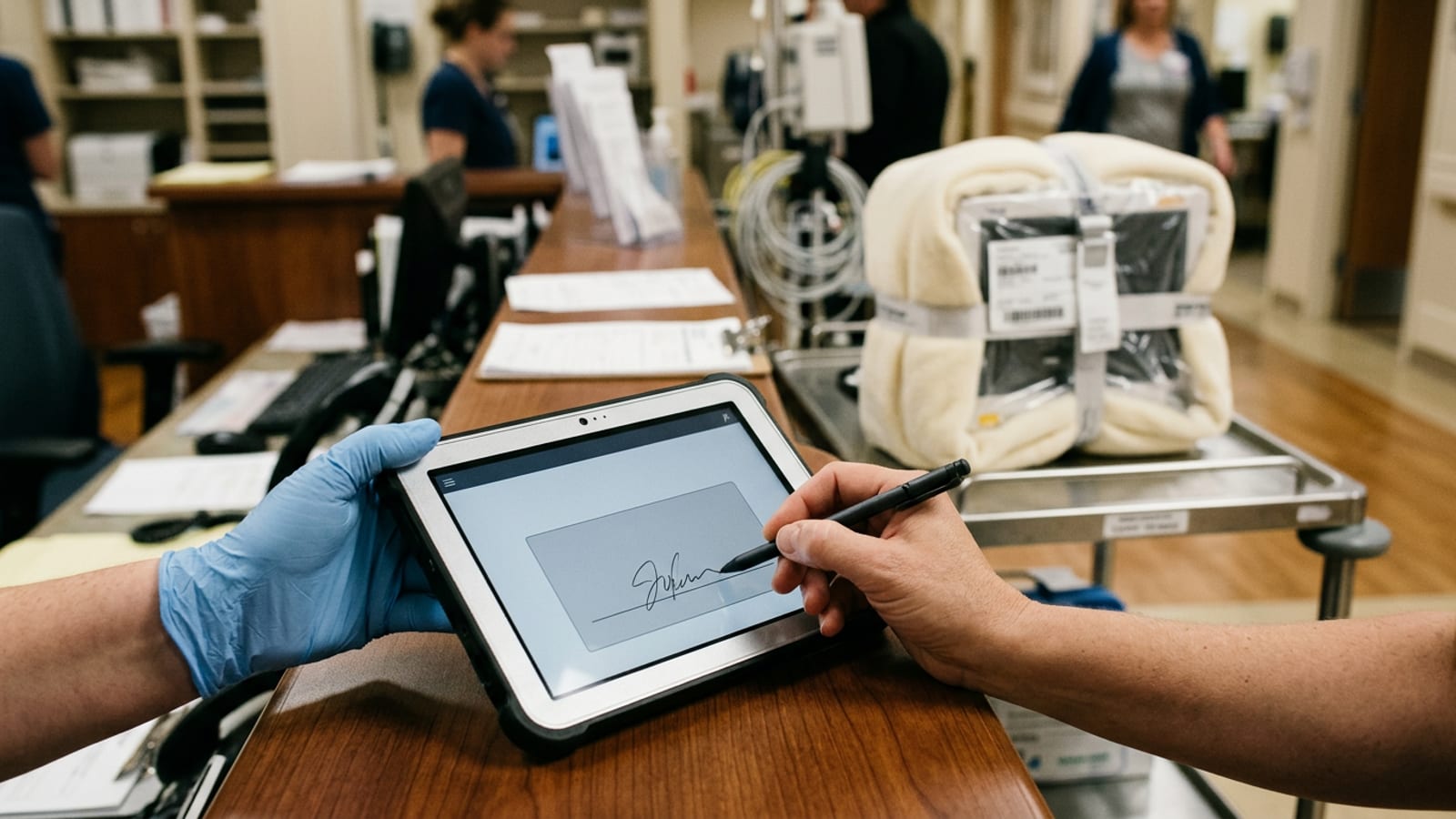
A medical device is not just hardware. Many of the devices hospitals move between buildings, to repair shops and to new owners carry patient information inside them.
That changes what “good handling” means. Arriving on time and undamaged is still the baseline. On top of that, a hospital should be able to say exactly who had the device at every point between release and receipt. Here is what that chain of custody should look like, and how to tell whether a logistics vendor takes it seriously.
The devices that carry patient information
It is easy to think of patient data as something that lives in the records system. In practice, a lot of it ends up on the equipment itself. Common examples:
- Imaging systems. Ultrasound units, portable X-ray and C-arm workstations often keep studies, patient names and identifiers on local storage.
- Patient monitors. Bedside and transport monitors can hold trend data, alarm histories and patient details.
- Infusion pumps. Many keep event logs and, depending on setup, details tied to the patient or the order.
- Lab analyzers. These can store results, sample identifiers and run histories linked back to patients.
Whether a particular device is wiped before it moves is a decision for the hospital. A careful logistics company handles every one of these as if data is still on board.
What chain of custody means for a moved device
Chain of custody is an unbroken, documented record of who held an item, from the moment it left one person's control to the moment someone else accepted it. For a device that holds patient information, that record is what lets a hospital answer simple but important questions later: where did it go, who touched it, and when did it change hands?
Signed handoffs at both ends
The chain starts with a signature at pickup. The releasing contact confirms the device is leaving, and the driver records its condition. It ends with a signature at delivery from the person authorized to accept it. If either signature is missing, there is a gap, and gaps are exactly where questions go unanswered.
Ask a vendor to show you what a completed pickup and delivery record looks like. If they cannot, that tells you something.
Sealed, direct transport with fewer hands
Every transfer adds a person, a location and a chance for something to go wrong. A device that rides through a sort facility or sits on a shared dock passes through hands you never see. Direct transport keeps it simple: one vehicle, one driver, one trip. The device stays wrapped and secured, the vehicle stays locked when the driver steps away, and it is not left anywhere without a signature.
Who is allowed to receive
Before the run, the hospital should name the person, or the role, allowed to sign at the destination. A good driver will not hand a device to whoever happens to be standing near the door, and will not leave it in a hallway to save time. If the named receiver is not available, the right move is to call dispatch and the hospital contact, not to improvise.
GPS records as part of the trail
Signatures show where a device started and finished. GPS tracking shows the path in between. Together they give a fuller picture of the run: when the vehicle left, the route it took, and when it arrived. If your team ever needs to reconstruct a delivery, that location history fills in what paperwork alone cannot.
Questions to ask a logistics vendor
Put these to any company you are considering for moves that involve patient data:
Driver training. How are drivers trained on patient privacy, and to what standard? Ask for a plain description, not a slogan.
Direct transport. Will the device be the only load on the vehicle, and will it go straight from pickup to delivery?
Signatures. Who signs at pickup and at delivery, and what exactly does the record show?
Unavailable receiver. What happens if the named person is not there when the driver arrives?
Unattended equipment. Is a device ever left in an unlocked vehicle, at a dock or at a door without a signature?
Location records. Can you get the GPS record for a specific run if your team needs it later?
How USA Medical Hot Shot Transporters fits
Our drivers are trained to HIPAA standards. We run hot shot and STAT delivery of critical medical equipment, so a device can go direct instead of through a terminal, and runs are GPS tracked. Dispatch is open 24/7/365 with a person answering, which means your team can confirm release and receiving contacts with someone who can act on them. You can see the kinds of devices we move in the Equipment section and the flow of a run in How it works.
From our regional hub in Richmond, VA, we serve Virginia, North Carolina, South Carolina, Maryland and Washington DC, including Rockville, Arlington, Charlotte and Charleston. See the full Coverage map, or read the FAQ.
Frequently asked questions
- Which medical devices are likely to store patient data?
- Imaging systems, patient monitors, infusion pumps and lab analyzers commonly keep some patient information, logs or results on the device. Your biomed or IT team can confirm what a specific model stores.
- Why does a signed handoff at pickup and delivery matter?
- It creates a clear record of who had the device and when. If a question ever comes up about where a device went or who handled it, that record is what answers it.
- How are your drivers trained on patient privacy?
- Our drivers are trained to HIPAA standards. Call dispatch at 1-866-216-7742 if your compliance team has questions about how runs are handled.
- Should we wipe a device before it is shipped?
- That is a decision for your biomed, IT and compliance teams, and it often depends on where the device is going and why. This is general information, not legal advice.
Moving devices that hold patient data? Talk to dispatch first.
Tell us what is moving, who will release it and who will receive it, and we will plan a direct, GPS-tracked run with drivers trained to HIPAA standards.
See more runs and tips on our Facebook page (opens in a new tab)